
Unmounted Exercises for Common Positional Problems
Here are some generalised tips and rider exercises if you are experiencing any of the following in the saddle.
Disclaimer: As stated, this is generalised physiotherapy exercises and information. This content is not intended as a substitute for individualised advice, diagnosis or treatment. Please seek the advice of your Physiotherapist of Physician with any questions you may have regarding a medical condition or injury, and its treatment prior to commencing these sessions. Cease performing an exercise if you experience any pain, discomfort, dizziness or altered sensation. In such event, please contact your Physiotherapist prior to continuing. If you have a heart condition, uncontrolled blood pressure or any other medical problem that renders you unable to exercise, please do not proceed with the following exercises. Participating in exercise poses a risk of physical injury. If you engage in these exercises, you do so at your own risk, are voluntarily participating, assume all risk of injury, and agree to release and discharge The Riders Physio from any and all claims or causes of action, known or unknown, arising out of The Riders Physio generalised exercises for riders.
Gripping + Blocking
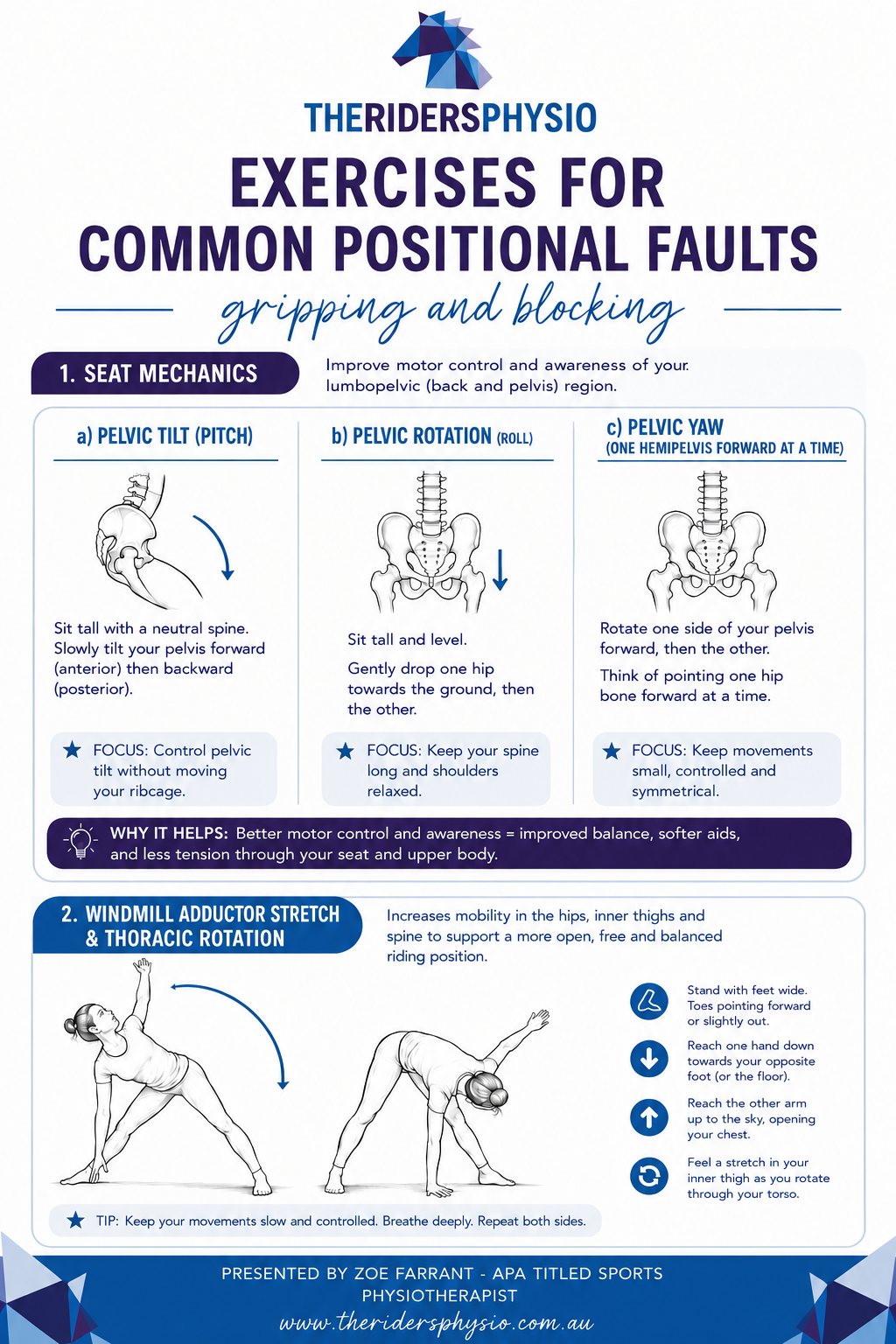
To remain ‘in phase’ and avoid blocking with your seat, try the following exercises. The three pelvic movements form the ‘Seat Mechanics,’ that allow you to move with the horses back and rib cage in a coordinated way. Optimising your motor control, proprioception and balance in this region leads to a more symmetrical and centered seat and enhances the riders ability to perform an effective half halt.
Riders who grip and block, often have overactivity of their adductor (inner thigh) muscles relative to their abductor (outside of hip) muscles, and tight upper backs. Try the Windmill before mounting and see if it helps.
2. Hunched posture
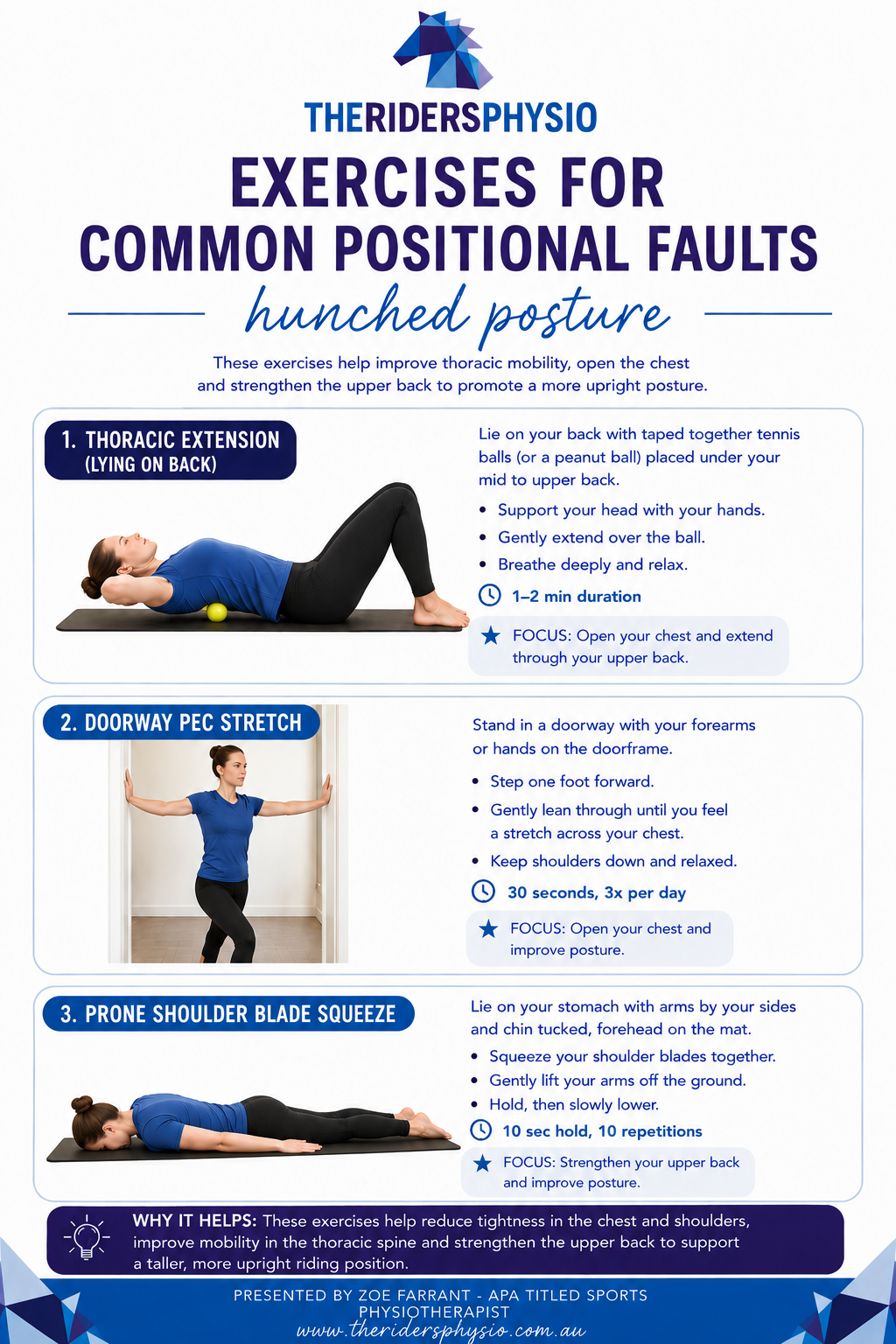
These days with our modern day lives, its common for riders to struggle to ‘sit up’ even with frequent prompting by their coach. This can be due to a number of reasons including tight pectoral (chest muscles) pulling the shoulder girdle forward, restricted thoracic (upper back) mobility, nervousness and anxiety, and the list goes on. The scapular being depressed and protracted can increase the risk of shoulder over load, and increased thoracic kyphosis and chin poke postures commonly contribute to neck related headaches and neck pain.
The following release, stretch and mobility exercises can be effective at improving dynamic posture in the saddle if completed several times a week, and especially prior to riding.
3. Pulling heels up
There are many reasons why the rider may ride with their heels pulled up despite being instructed otherwise.
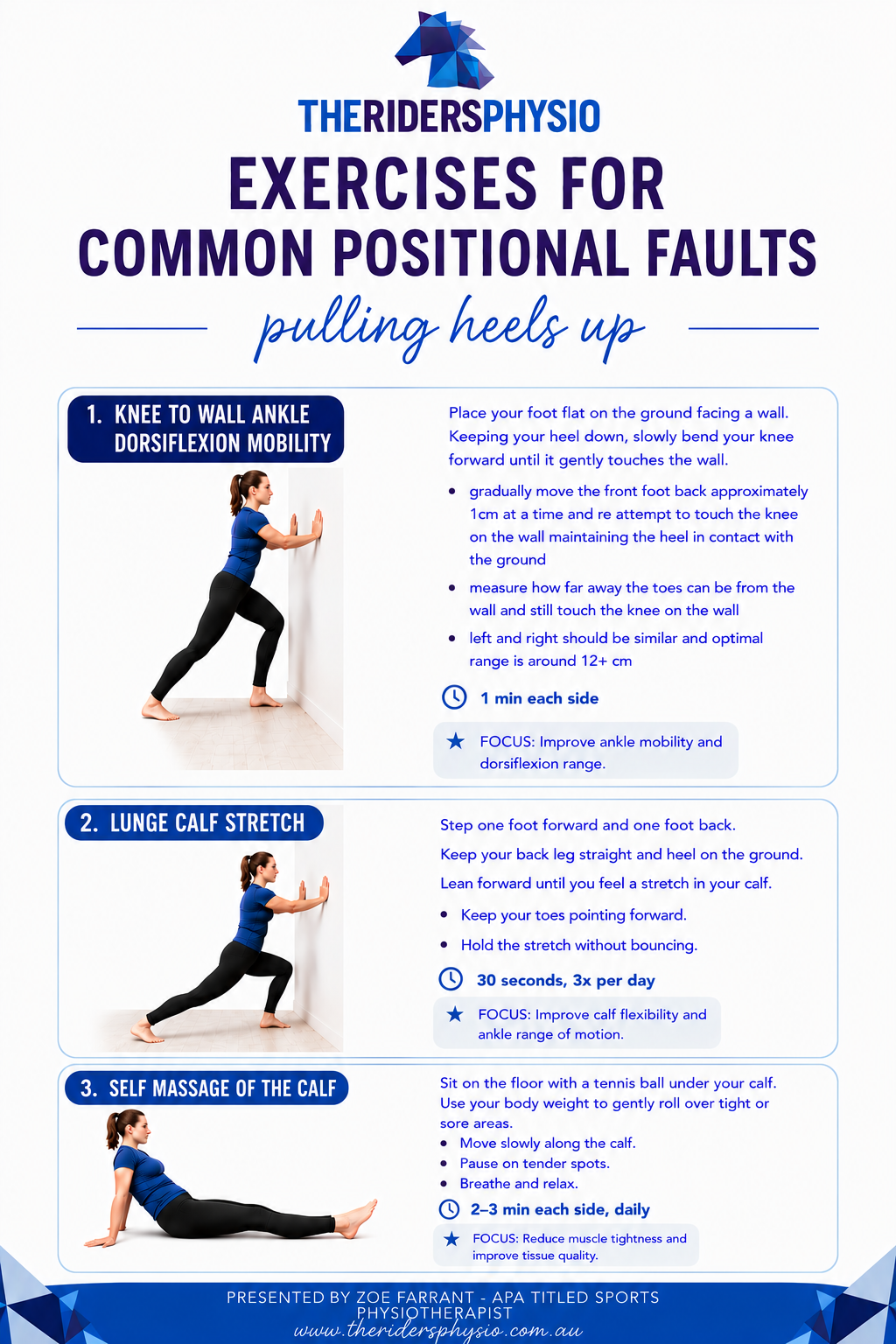
One reason is ankle joint dorsiflexion stiffness, causes of which are many. After an ankle sprain, this movement often stiffens and isn’t always restored without rehab exercises/manual therapy. Another reason why the rider may pull their heels up is tight calf muscles. Both of these problems should be responsive to stretching the calf and mobilising the ankle joint.
The following release, stretch and mobility exercises can be effective at improving the lower leg position in the saddle if one or both of these causes are the culprit.
Keep in mind, the heels pulling up can also be due to poor proximal stability and motor control, which is unlikely to be influenced by these exercises or similar.
4. UNSteady/ineffective leg aids:
For the rider with unsteady legs or ineffective leg aids the following should be considered:
proximal motor control and balance (seat, trunk, hips)
hip adductors (inner thigh): hip abductors (lateral hip muscles) strength and ratio
strength and endurance of the quadriceps (front of thigh muscles) that enable controlled rising trot, two point and ‘light seat’ leg positioning
calf muscle length and soleus strength (for jump riders especially)
hamstring and hip flexor length and capacity
Ankle dorsiflexion range, spinal and hip mobility
NB: A rider who is in the habit of gripping with the knee/thigh (as most novice riders tend to do) will often have unsteady/swinging lower leg.
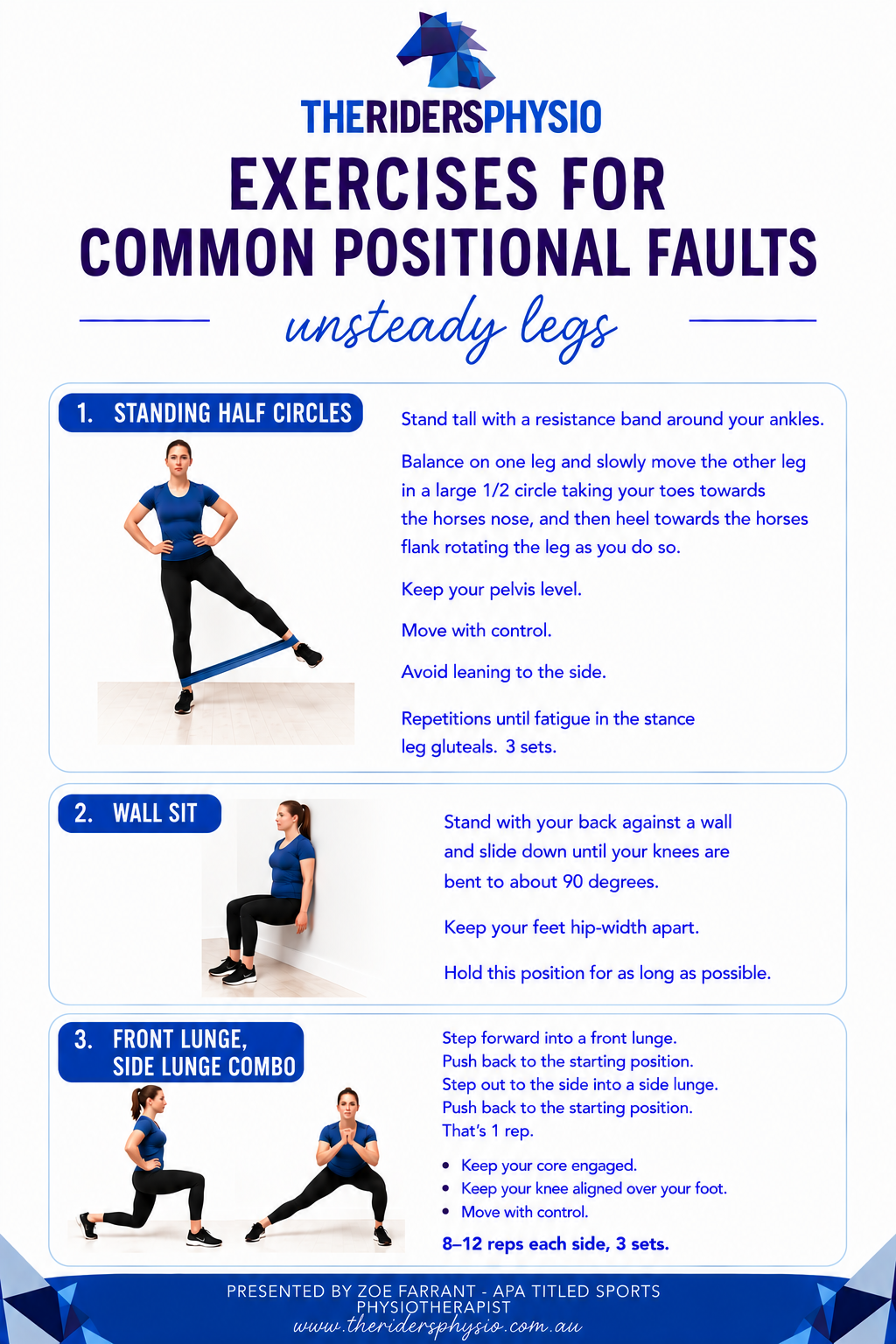
The following exercises help activate the hip abductors (lateral hip muscles) to counteract the action of the adductors (inner thigh) gripping, and enable the rider to take the leg off the horse intentionally, to then apply a succinct leg aid, strengthen the thigh muscles to help control the leg position especially in rising trot, two point and light seat, and ‘open the hips’ dynamically stretching and strengthening the hip flexors and thighs.
You can try one set of each before you mount as a warm up/dynamic mobility and activation as well as completing 3 sets of each 2-3x per week as a off horse workout.
The Riders Physio Blog
(COVID lockdown benefit.. having time to make a blog)


